



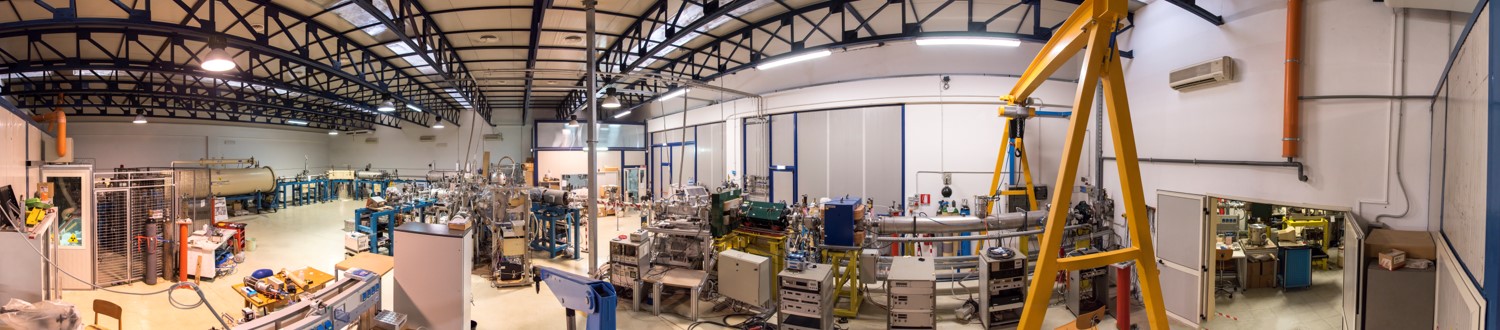
Polo dei Laboratori di Ricerca (PoLaR)

IT
PoLaR occupa circa 3000 m² di laboratori, 1100 m² di uffici, 1500 m² di aree di stoccaggio, 200 m² di officine elettro-meccaniche e ospita circa 30 unità di personale, tra personale docente e tecnico. Presso PoLaR sono inoltre ospitate attività di INFN, CIRA e CNR.
PoLaR si è sviluppato a partire dal nucleo sperimentale di CIRCE (tuttora operante nell’ambito del PoLaR come Laboratorio), istituito nel 2005 nell’ambito dell’omonimo centro di competenza. Con il passaggio della gestione al DMF, l’ampliarsi delle attività ospitate e le recenti opere per l’installazione del laboratorio CAPACITY (Campania AstroPArtiCle InfrastrucTure facilitY), il nuovo laboratorio è stato rinominato PoLaR.
Oltre alla ricerca, il CIRCE‑PoLaR rappresenta una risorsa fondamentale per l’attività didattica del Corso di Laurea in Fisica e ospita la sede di ISOCORE SRL, spin‑off accademico dell’Università degli Studi della Campania “Luigi Vanvitelli”.
CAPACITY‑PoLaR è un punto di riferimento all’interno della Collaborazione KM3NeT (Cubic Kilometer Neutrino Telescope): è l’unico laboratorio dell’intera e vasta collaborazione in cui vengono eseguite tutte le fasi di integrazione e calibrazione, dai singoli fotomoltiplicatori ai DOM (Digital Optical Modules), fino alle DU (Detection Unit) e alle Base Unit. CAPACITY costituisce inoltre un laboratorio di ricerca pronto a ospitare esperimenti di fisica delle astroparticelle, con evidenti ricadute nell’ambito della terza missione.
Il CIRCE‑PoLaR ospita un laboratorio dotato di un acceleratore elettrostatico tandem da 3 MV (Tandem Accelerator Laboratory, TAL), installato nel 2005 e coinvolto in progetti di ricerca che spaziano dall’astrofisica nucleare allo studio dei cambiamenti climatici globali, dall’archeologia alla sicurezza nucleare, con applicazioni che includono il monitoraggio ambientale e la valutazione dell’usura dei materiali su scala sub‑micrometrica. Il TAL, attraverso la Spettrometria di Massa Ultrasensibile con Acceleratore (AMS), fornisce un servizio di datazione radiocarbonica per reperti archeologici e svolge analisi forensi.
Il Laboratorio di Spettroscopia Laser, attivo dal 1996, si occupa dell’osservazione e dello studio di spettri atomici e molecolari mediante metodologie innovative ad alta risoluzione, precisione e accuratezza, spesso combinate con un’altissima sensibilità di rivelazione. Qui vengono realizzati test di teorie quantistiche, affiancati da applicazioni alla metrologia fondamentale. Allo stesso tempo, vengono forniti parametri spettroscopici di alta qualità per atomi e molecole di interesse per le scienze delle atmosfere terrestri e planetarie, la fisica del clima, la fisica dei plasmi e l’astrofisica.
Presso il CIRCE‑PoLaR sono presenti diversi laboratori di Spettrometria di Massa per rapporti isotopici stabili: spettrometria di massa a sorgente gassosa (IRMS) per elementi leggeri e spettrometria di massa ICP con multicollettore (MC‑ICP‑MS). I laboratori offrono supporto tecnico alla ricerca applicata nei settori agroalimentare, geologico, ambientale e archeologico.
Il Laboratorio di Radioattività Ambientale ospita uno spettrometro gamma con rivelatore al Germanio Iperpuro (HPGe), che consente la rivelazione e quantificazione di radionuclidi gamma‑emettitori con elevata risoluzione e basso fondo, spingendo i limiti di rivelazione alle ultra‑tracce. È inoltre presente uno scintillatore liquido per la determinazione del Trizio e di altri radionuclidi quali il 14C. Lo spettrometro a Fluorescenza a Raggi X (XRF) permette l’analisi elementare non distruttiva dei materiali.
Il laboratorio fornisce supporto alle ricerche riguardanti la salvaguardia ambientale, la salute pubblica e il patrimonio culturale.
Presso il CIRCE‑PoLaR sono inoltre presenti: i) un laboratorio di microscopia elettronica a scansione con spettroscopia a dispersione di energia dei raggi X (SEM‑EDS), per analisi morfologiche e composizionali di campioni nei settori dei materiali, dell’ambiente e dei beni culturali; ii) due laboratori dedicati alla preparazione chimica dei campioni; iii) una camera ultra-pulita con due ambienti ISO 4 dotati di cappa con bussola ISO 8; iv) un laboratorio con un evaporatore per la deposizione di film ultrasottili.
EN
The Research Laboratories Hub (PoLaR) represents the experimental infrastructure of the Department of Mathematics and Physics (DMF).
PoLaR covers approximately 3,000 m² of laboratories, 1,100 m² of offices, 1,500 m² of storage areas, and 200 m² of electro-mechanical workshops, and hosts about 30 staff members, including academic and technical personnel. It also accommodates activities of INFN, CIRA, and CNR.
PoLaR developed from the experimental core of CIRCE (still operating within PoLaR as a laboratory), established in 2005 within the framework of the competence center of the same name. Following the transfer of management to the DMF, the expansion of hosted activities, and recent works for the installation of the CAPACITY laboratory (Campania AstroPArtiCle InfrastrucTure facilitY), the facility was renamed PoLaR.
In addition to research, CIRCE–PoLaR is a key resource for teaching activities in the Physics degree program and hosts the headquarters of ISOCORE SRL, an academic spin-off of the University of Campania “Luigi Vanvitelli.”
CAPACITY–PoLaR is a reference point within the KM3NeT (Cubic Kilometer Neutrino Telescope) Collaboration: it is the only laboratory in the entire collaboration where all phases of integration and calibration are carried out, from individual photomultipliers to Digital Optical Modules (DOMs), up to Detection Units (DUs) and Base Units. CAPACITY is also a research laboratory ready to host experiments in astroparticle physics, with clear impacts on third mission activities.
CIRCE–PoLaR hosts a laboratory equipped with a 3 MV electrostatic tandem accelerator (Tandem Accelerator Laboratory, TAL), installed in 2005 and involved in research projects ranging from nuclear astrophysics to global climate change studies, from archaeology to nuclear security. Its applications include environmental monitoring and the evaluation of material wear at the sub-micrometric scale. Through Accelerator Mass Spectrometry (AMS), the TAL provides radiocarbon dating services for archaeological findings and performs forensic analyses.
The Laser Spectroscopy Laboratory, active since 1996, focuses on the observation and study of atomic and molecular spectra using innovative high-resolution, high-precision, and high-accuracy methodologies, often combined with extremely high detection sensitivity. It supports tests of quantum theories as well as applications in fundamental metrology. At the same time, it provides high-quality spectroscopic parameters for atoms and molecules of interest in atmospheric and planetary sciences, climate physics, plasma physics, and astrophysics.
Within CIRCE–PoLaR, several laboratories for stable isotope ratio mass spectrometry are available: gas-source isotope ratio mass spectrometry (IRMS) for light elements and multicollector ICP mass spectrometry (MC-ICP-MS). These laboratories provide technical support for applied research in the agri-food, geological, environmental, and archaeological sectors.
The Environmental Radioactivity Laboratory hosts a gamma spectrometer with a High-Purity Germanium (HPGe) detector, enabling the detection and quantification of gamma-emitting radionuclides with high resolution and low background, reaching ultra-trace detection limits. A liquid scintillation system is also available for the determination of tritium and other radionuclides such as 14C. An X-ray fluorescence (XRF) spectrometer allows non-destructive elemental analysis of materials.
The laboratory supports research related to environmental protection, public health, and cultural heritage.
CIRCE–PoLaR also includes:
i) a scanning electron microscopy laboratory with energy-dispersive X-ray spectroscopy (SEM-EDS) for morphological and compositional analyses of samples in materials science, environmental studies, and cultural heritage;
ii) two laboratories dedicated to chemical sample preparation;
iii) an ultra-clean room with two ISO 4 environments equipped with an ISO 8 airlock hood;
iv) a laboratory equipped with an evaporator for the deposition of ultra-thin films.
Laboratorio di Biofisica delle Radiazioni
IT
Le attività di ricerca che si svolgono presso il Laboratorio di Biofisica delle Radiazioni sono tra quelle di più recente istituzione al PoLaR. Queste sono fortemente interdisciplinari e riguardano lo studio degli effetti biologici delle radiazioni ionizzanti ed il ruolo che vi hanno i processi di deposizione energetica su scala molecolare, presentando un ampio ventaglio di applicazioni, che spaziano dalla radioterapia alla radioprotezione nello Spazio. In ambito radioterapico, le attività di Biofisica delle Radiazioni sono incentrate sulla caratterizzazione delle proprietà radiobiologiche dei fasci di particelle accelerate usati attualmente nell’adroterapia antitumorale, con un interesse verso ioni “emergenti”, non ancora adottati nella pratica clinica (quali l’elio). Più di recente, nell’ambito del progetto PNRR ANTHEM, studi sono in corso sui meccanismi biomolecolari alla base di un altro approccio terapeutico caratterizzato da un fondamentale contributo della fisica, la Boron-Neutron Capture Therapy (BNCT). Il Laboratorio di Biofisica delle Radiazioni è attrezzato per il mantenimento e la manipolazione di colture cellulari, e per la quantificazione dei principali effetti citogenetici e biomolecolari radioindotti, mediante l’uso di tecniche quali ibridizzazione cromosomica e marcatura immunofluorescente, e di strumentazione che comprende microscopia a fluorescenza e citometria a flusso.
EN
The research activities carried out at the Radiation Biophysics Laboratory are among those more recently established at PoLaR. These are highly interdisciplinary and address the study of the biological effects deriving from the exposure to ionising radiation and thereof underlying biophysical mechanisms linked to the processes of energy deposition at the molecular scale. The wide-ranging implications of such research encompass biomedical applications such as cancer radiotherapy as well as radioprotection in Space. Within radiotherapy, the activities of Radiation Biophysics are focussed on the radiobiological properties of the accelerated particle beams currently used in hadrontherapy, with a particular interest towards “emerging” ions, such as helium. More recently, within the PNRR ANTHEM project, studies are under way on the biomolecular mechanisms on which the Boron-Neutron Capture Therapy (BNCT) relies, this being another antitumoral strategy where the contribution of physics is fundamental. The Radiation Biophysics Laboratory is equipped for the maintenance and processing of cell cultures, and for the quantification of the main radiation-induced cytogenetic and biomolecular effects at the cellular and DNA level, using techniques such as chromosome hybridization and immunofluorescence, and instruments including fluorescence microscopy and flow cytometry.
Laboratorio di calcolo scientifico
IT
EN
The Scientific Computing Laboratory (LCS), named after Prof. Marco D’Apuzzo, is a facility dedicated to the development, analysis and application of numerical methods and software for solving problems in the field of Scientific Computing, in support of the research activities of the Department of Mathematics and Physics.
The laboratory is located on the first floor of the Department.
The laboratory is used by academic staff, PhD students, research fellows and students working on their degree theses. It also represents an essential teaching infrastructure for all the Department’s degree programmes, as well as for research activities.
The laboratory infrastructure consists of 11 desktop PCs running Linux Mint 22.3 Mate 64-bit (kernel 6.17.0-19), equipped with 6-core Intel Core i7-8700 processors, 16 GB of RAM and partitioned 1 TB hard drives.
The laboratory also includes a server with Xeon processors dedicated to network services, user management and the license manager.
The software available includes MATLAB, R and RStudio, Python development environments, text editors, and compilers for the C, C++ and Fortran languages (gfortran), supporting the main scientific computing activities.
The laboratory is connected to a high-speed data network and can be accessed remotely through a gateway to the University network, thus allowing flexible use of its resources for both teaching and research.
Access to and use of the laboratory resources are subject to prior reading and acceptance of the relevant regulations.
Laboratorio di programmazione e calcolo
IT
Il Laboratorio di Programmazione e Calcolo è utilizzato per attività didattiche nell'ambito dei corsi di laurea triennale e magistrale che afferiscono al Dipartimento di Matematica e Fisica. Il laboratorio fornisce il necessario supporto all'insegnamento delle discipline applicative nell'ambito di tali corsi, oltre ad offrire a tutte le discipline scientifiche l'opportunità di realizzare momenti di integrazione tra didattica frontale ed esperienze di laboratorio. Il laboratorio mette a disposizione 40 PC, dotati di sistema operativo Linux, di compilatori C/C++/Fortran, di ambienti di programmazione Java e Python, dell'ambiente MATLAB, di software di base per il calcolo scientifico. Il laboratorio è anche dotato di un server PostgreSQL e di software di interfacciamento, nonchè di software di supporto all'insegnamento di varie discipline della matematica, della fisica e dell'informatica. In ambiente Linux i PC costituiscono un cluster, con una gestione centralizzata degli utenti e del file system.
Responsabile: prof. Stefano Marrone
Responsabile tecnico: dott. Stefano Angelone
Responsabile amministrativo: dott. Dario D'Alessandro
Gli utenti interessati a usare le risorse del laboratorio sono invitati a leggere il regolamento, a scaricare e compilare la dichiarazione di presa visione e a caricarla seguendo questo link.
EN
The Programming and Calculation Laboratory is used for teaching activities within the framework of the Bachelor's and Master's degree courses that belong to the Department of Mathematics and Physics. It provides the necessary support for the teaching of applied disciplines within the framework of these courses, as well as offering all scientific disciplines the opportunity to realise moments of integration between frontal teaching and laboratory experiences. The laboratory provides 40 PCs, equipped with the Linux operating system, C/C++/Fortran compilers, Java and Python programming environments, the MATLAB environment, and basic software for scientific computing. The laboratory is also equipped with a PostgreSQL server and interfacing software, as well as software to support the teaching of various disciplines of mathematics, physics and computer science. In a Linux environment, the PCs form a cluster, with centralised management of users and the file system.
Reference: prof. Stefano Marrone
Technical reference: dott. Stefano Angelone
Administrative reference: dott. Dario D'Alessandro
Users interested in using the workshop resources are invited to read the regulations, download and complete the acknowledgement statement and upload it by following this link.
Laboratorio didattico di Fisica
IT
Il Laboratorio didattico di Fisica è situato in un ampio locale dell’edificio C del Dipartimento di Matematica e Fisica, in via Vivaldi a Caserta. È dotato di una vasta gamma di materiali e strumentazioni che consentono lo svolgimento di numerose attività sperimentali rivolte agli studenti afferenti al Dipartimento, ad altri corsi di laurea che prevedono insegnamenti di fisica e, in alcune occasioni, anche ad alunni e docenti delle scuole del territorio.
Il laboratorio rappresenta un ambiente fondamentale per avvicinare gli studenti alla fisica sperimentale e per introdurli all’utilizzo del metodo scientifico di tipo galileiano. È attrezzato per la realizzazione di esperimenti nei principali ambiti della fisica classica, quali meccanica, termodinamica, ottica, elettricità e magnetismo. Dispone inoltre di apparati dedicati alla fisica moderna, tra cui dispositivi a semiconduttore, circuiti di elettronica analogica e digitale, il tubo di Thomson, l’apparato per l’esperimento di Millikan, il cubo di Leslie, pannelli fotovoltaici e un interferometro di Michelson.
Il laboratorio è utilizzato anche nell’ambito della LabVIEW Academy per attività di progettazione e realizzazione di sistemi di misura e automazione, simulazione e interfacciamento hardware.
Durante le attività laboratoriali, gli studenti sono guidati nello svolgimento di esperimenti con un grado di complessità commisurato al corso di laurea e allo specifico insegnamento. Particolare attenzione è rivolta alle metodologie sperimentali e alla corretta valutazione delle incertezze di misura associate agli strumenti e ai metodi utilizzati.
Il laboratorio non ha solo la funzione di verificare leggi teoriche, ma offre agli studenti l’opportunità di acquisire competenze pratiche nella manipolazione degli strumenti, nella progettazione di procedure di misura, nell’analisi dei dati e nella valutazione degli errori sperimentali, anche mediante l’uso di metodi statistici. Le attività si svolgono in gruppi di due o tre studenti, favorendo il lavoro collaborativo e l’apprendimento tra pari.
Il laboratorio può ospitare fino a 50 studenti contemporaneamente. Ogni gruppo dispone della strumentazione necessaria per lo svolgimento delle attività e di un computer per l’analisi dei dati e la redazione della relazione finale.
La gestione tecnica e organizzativa del laboratorio è curata dal Dott. Antonio Petraglia, mentre la responsabilità scientifica è affidata al Prof. Carlo Sabbarese.
EN
The Physics Teaching Laboratory is located in Building C of the Department of Mathematics and Physics, on Via Vivaldi in Caserta.
It is equipped with a wide range of materials and instruments that make it possible to carry out numerous experimental activities for students belonging to the Department, for students enrolled in other degree programs that include physics courses, and, on some occasions, also for school students and teachers from the local area.
The laboratory is a fundamental environment for introducing students to experimental physics and to the use of the Galilean scientific method. It is equipped for experiments in the main areas of classical physics, such as mechanics, thermodynamics, optics, electricity, and magnetism. It also includes equipment dedicated to modern physics, including semiconductor devices, analog and digital electronics circuits, the Thomson tube, the apparatus for the Millikan experiment, the Leslie cube, photovoltaic panels, and a Michelson interferometer.
The laboratory is also used within the framework of the LabVIEW Academy for activities involving the design and implementation of measurement and automation systems, simulation, and hardware interfacing.
During laboratory activities, students are guided in carrying out experiments with a level of complexity appropriate to the degree program and the specific course. Particular attention is given to experimental methodologies and to the correct evaluation of measurement uncertainties associated with the instruments and methods used.
The laboratory does not serve only to verify theoretical laws, but also offers students the opportunity to acquire practical skills in handling instruments, designing measurement procedures, analyzing data, and evaluating experimental errors, including through the use of statistical methods. Activities are carried out in groups of two or three students, encouraging collaborative work and peer learning.
The laboratory can accommodate up to 50 students at the same time. Each group has the equipment necessary to carry out the activities and a computer for data analysis and for writing the final report.
The technical and organizational management of the laboratory is overseen by Dr. Antonio Petraglia, while scientific responsibility is entrusted to Prof. Carlo Sabbarese.